Monday, August 20, 2007

CAMBRIDGE MASTERS CAMP 2007

This year's version of the Ontario Speed Skating Association's Summer Speed Camp included a masters category consisting of 3 half-days during August 20 to 22. Held in Cambridge's Hespeler Arena on olympic-size ice, 18 masters skaters participated with representation from many of the clubs in the province including London, Kitchener-Waterloo, Niagara, Milton, Hamilton, Oakville, Toronto, Peterborough, Kingston, Ottawa and Gloucester.

Coaching was capably handled by Todd Landon, OSSA's Director of Sport Development and a Level 3 coach with over 20 years of experience in speed skating.

DAY ONE

There was no time wasted getting onto the ice with the masters first-up at 8:00 am on Rink 1. In order to "re-hardwire brains to muscles", Coach Todd had all warm-up laps and drills skated in a clockwise direction except for the last 6 laps. With a focus on straight-away technique including balance, edge control and weight transfer, Todd's strategy was to get skaters thinking about what they were doing.

Then, it was into the Viewing Gallery for an equipment session focused on blade rocker & bend including the use of gauges as well as sharpening techniques. Campers had the opportunity to use several gauges to measure and record the condition of their own equipment.


Next, it was outdoors for the Beep (20 m shuttle) Test. Run back and forth between 2 lines 20 m apart in synch with a pre-recorded timing sequence of gradual increasing tempo, the test is designed to assess the basic fitness level of participants. Former national team member and Speed Skating Canada's long term athlete development guru, Shawn Holman, assisted with the test. In his post-session presentation of the test results, Shawn complimented the masters on their general fitness level. Cameron Boyd, of London, was the most enduring, lasting well into the Level 12 stage with his spent comrades cheering him on until he could go no more.After some light cool-down and stretching to rid the lactate from our legs, it was back to the ice for the final session of the day focused on cornering technique. Drills included balance, weight transfer and edge control mercifully carried out in a counter-clockwise direction.

DAY TWO

With the side-effects of Hurricane Dean in the air, campers took to the outdoors at 8:00 am under gray threatening skies. After a quick warm-up run through the neighbouring streets and some dynamic stretching drills in the arena parking lot, masters were led through a series of ladder agility drills by Coach Todd.

Then, it was on to dryland imitations and balance drills with the optional extra challenge of standing on a tube of foam rubber.Next, the morning's first ice session continued with more advanced cornering and straight-away drills. Tight corners were negotiated on 2 skates, right skate, left skate, hard right push - glide left and half-crossover - glide right. Different track patterns were skated by varying the number of crossovers before and after the apex corner block including "1 in 2 out", and "2 in 2 out". Straight-away drills included variations of power accel's and tempo accel's.

Once off the ice, campers had a chance to rest their bodies, but not their brains, as Coach Todd explained passing strategies and relay techniques.

Then, it was off for a Bosu class led by Heidi and Shannon. All masters finished sweating after being led through a series of challenging drills that covered the full spectrum of balance, strength, agility, plyometrics, endurance and flexibility. This was tough work!

The final ice session of the day started with straight-aways focused on extending the recovery leg and driving it through with weight transfer for powerful pushes. Next, it was corner accel's from the entry block crossing-over all the way past the exit block to the centre of the straight-away. Working in pairs, campers did preliminary passing drills and then ended the session with 2 sets of 12 laps of variable intervals - easy, medium and hard.

The day concluded with a roundtable discussion about masters speed skating in Ontario facilitated by Sheila McGinn (who also arranged for pizza to keep everyone fueled). There were excellent comments and suggestions from all campers including interesting insights into how masters are accommodated in each of the 12 provincial clubs represented. More on this later - likely from Sheila who is Ontario's representative to the Canadian Masters Speed Skating Committee formed last February at Calgary's Olympic Oval during the 16th Masters International Speed Skating Games.

DAY THREE

After a quick warm-up run, the camp re-commenced at 8:00 am with a session on stretching led by former Kitchener-Waterloo and Montreal International speed skater, Christina Walsh - now a competitive cyclist and graduate physiotherapist from McGill University. Following some elementary theory, Christina led campers through an interactive demonstration of static stretching followed by a quick explanation of dynamic stretching.

Then, it was on to the ice for the day's first session which commenced with variable intervals and continued with accel's on both straight-aways and corners. Next was an introduction to relay pushes including laps of exchanges working in pairs. Then, campers did 2 sets of relays in groups of 4 with each team member skating 4 x 1.5 laps.

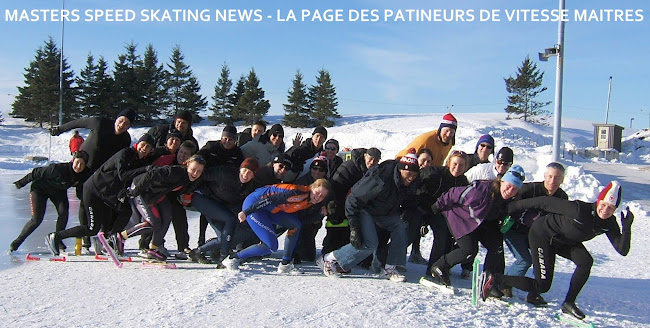
Back off-ice, masters were led through a fairly intense 45 minute spin class by Shannon.Then, a needed break was taken out in the play field where Coach Todd led a group discussion about personal goals, challenges and training, and then provided a dryland introduction to starts as a lead-up to the final ice session of the camp.Back on ice, campers did 2 sets of 10 and 12 laps applying techniques learned through the preceding 5 sessions. These included "decision laps", where Coach Todd called out for skaters to enter inside or outside a wide entry block just as they entered the corner. Then, working in pairs - skaters did starts with the partner providing added resistance using gigantic elastic bands. For the last drill of the camp, skaters did sets of 1/2 lap and full lap starts in groups of 4.After a fairly challenging day, campers posed for a group photo and then parted ways with some headed back to home & work and others remaining to care for their children (also in the camp) or to assist with coaching younger skaters.The consensus of all masters was that the camp was a resounding success with expressions of graditude to Coach Todd and camp organizers at the Cambridge Speed Skating Club including Blake Morrison. There were many hopes for the camp to continue next summer in Gloucester.

Saturday, August 18, 2007

MONT STE. MARIE MASTERS CAMP 2007

Many thanks to Sheila McGinn for her wonderful account of this unique camp:

Mont Ste. Marie Masters Dry Land Camp August 10-12, 2007

In his book “Mastery”, George Leonard writes of the journey to mastery that many athletes follow. To support us on this journey, the Ottawa Pacers have sponsored the 2007 Mont Ste. Marie Masters Dry Land Camp. Ten masters members of the Pacers, plus three of our fellow masters from Quebec and New York, have assembled in Mont Ste. Marie for a weekend of instruction and practice, hopefully on the road to mastery.

Mike and Carleen Rivet are hosting the camp. Colleen Janusauskas will help Carleen with the task of keeping us nourished, and Gavin Thulien and Grant Edgar will assist Mike with the coaching.

Mike is our regular long track coach, so most of us have an idea of what we’re in for. It will be fun, but it will be difficult, and we can’t wait to start. I’ve got my bathing suit, my towel and my sleeping bag, and I’m off to camp!

Day One

Friday afternoon starts with what Mike describes as a “light workout”. This pretty much fits with my expectations of a hill run, but Mike says that’s tomorrow. Up the hill, and core work. Down the hill, and imitations. Up the hill, different core work. Down the hill… you get the picture. Mike at the top of the hill, Gavin at the bottom. No escape. Apparently, we’re pretty slow, or at least some of us are. I check my heart rate monitor later, and sure enough, down was a lot faster than up.

We follow with some pure core work in the paddock, using a communal chair apparatus, and medicine balls… and play a game of partner tag, for agility and explosiveness.

It’s hot, we’re hot, but we make it to the lodge to change into our bathing suits before we jump into the lake.

Before supper, the expected nutritional lecture from Beth Mansfield
of Peak Performance turns out to be a much deeper appreciation of the physiology of the Masters Athlete. The change in our metabolism, what’s happening to our fast twitch and slow twitch muscle fibres, the impact on our recovery rate, and then how nutrition interacts with all of that.
Supper follows. Carleen has planned a series of meals that incorporate these good nutritional rules. The meatballs are hearty, and so are our appetites. After supper, there’s a campfire, complete with lessons on Tonya’s Djembe. For the energetic, that is - I hit the hay, being as I’m pretty sure Mike is serious about the 7 AM warm-up run.

Day Two

Sure enough, there’s a run at 7 AM. I’m used to 5 out / 5 in for warm-ups, but this is more like 10 and 10. This is not nearly as flat as Ottawa, and there’s footwork, too. At least the scenery’s beautiful. After the run, the skipping rope on the “to bring” list turns out to be for stretching. I’m late for this (thought I should be lining up for breakfast).

Big breakfast – Carleen’s done it again – followed by a group meeting to find out what Mike means by a hill run. Later, I find I’ve written “hell run” in my notes. This is huge. In my mind I pictured a road with an incline. Not a steep forest trail. The hill we could see from the lodge turns out to be the one we’ll look down on from the top.

Grant’s at the bottom, Gavin at the halfway checkpoint making sure we’re all still on the trail, and Mike’s at the top with the water bottles and treats. This will test our ankle strength and flexibility, our overall agility, our balance, our cardiovascular endurance, our strength endurance, our power, our coordination – not much will be missed.

We do two versions of the run. The first one’s alone. The next is a team effort – fastest with slowest, second with second last… the ropes we’re supposed to be using have gone missing, but we’re told to stay in close contact. The luck of the draw pairs me with Alain. I always enjoy an opportunity to train with a better athlete, just following in their path, trying to do what they do. It’s like that with Alain. He sights the trail markers, chooses the secure footing, I just have to try to keep up. On the steep parts, and it’s mostly steep parts, he extends a helping hand. Where it’s less steep, he encourages me as we run. A walkie-talkie problem at the critical moment means we don’t get our second time, but it’s definitely way better than my first attempt. Alain may be glad he doesn’t know how it compares to his first time, but he seems genuinely pleased with our result.

At the top the second time, there are treats specially prepared by Carleen to feed our recovery – putting our learning into action – and a chance to celebrate with our fellow campers.
Back at the bottom of the hill, after two ascents, no one feels like trekking back to the lodge for bathing suits, so it’s swim-as-you-are. Something about these group swims has everyone in high spirits, there are lots of laughs, and it feels good to cool down after a tough workout on a hot day.

There’s a little downtime after lunch. Somehow Gavin has scoffed a deal on an all-terrain skateboard. After trying variations of what appear to be more of Mike’s balance exercises, the smart people decide the dry land version of skeleton would be better. Marilyn gets the points for most distance, but Alain is clearly the overall winner for an Oscar-level performance / simulation of a close encounter with a tree.
Honestly, it’s not what it looks like… skateboards don’t develop a lot of momentum on grass.

Then the serious work begins. Frisbees and stretching for warm-up, then into the paddock for plyometrics with pylons and hockey sticks, medicine ball for core, agility ladders and finally the dreaded bungee cords (more plyometrics). Gail and Geneviève show us how it’s done:
It gets competitive at the end. The women whup the men… well, maybe by just a couple of seconds, but a clean win nonetheless.

We make it back for our bathing suits for the last swim of the day. Tom and Jim are triathletes-in-training and have decided to do a lake swim, so Geneviève and I take kayaks out as support boats. It’s perfect - a beautiful lake, the hypnotic rhythm of the experienced long distance swimmer, the sun glittering on the waves and suffusing us with a sense of well-being. A sweet day…

We spend the evening reviewing the day’s pictures, enjoying another awesome meal by Carleen and Colleen, attempting to sing around the camp fire, anticipating day three.

Day Three

Sunday starts with a warm-up ‘meander and games’, led by Alicia. After breakfast we have a group session on fitness. All the things we worked on yesterday, for sure. We also talk about rest, sleeping, and recovery. We suspect that’s homework. Gavin leads a discussion on the north, south, east and west of our development – technique, equipment, training, and nutrition.

The workout today consists of different simulations / imitations. Lots and lots of low walks (or low ‘ox’ according to one participant), and work on crossovers with ropes and belts and a good strong partner.
One last swim (didn’t make it back for my suit this time either), and it’s time for our final meal. We’d like to take Carleen home with us. We settle for the leftover treats.

Many thanks to Mike and Carleen, and to Colleen, Gavin and Grant, for all the planning and preparation, and all their work, support and encouragement. No injuries, no tears, lots of laughs, good food, good fun, we have to do this again next year! It was a great weekend, we all learned a lot, and it was, well, as much fun as going to camp.

Wednesday, August 01, 2007

ELLIS EDGE MASTERS CAMP 2007 - DAY 4

Here's Sheila's McGinn's Day 4 report:

Ellis Edge Masters Camp Day 4 – July 29, 2007

We start today with our before-and-after pictures. We work on the same sheet as the kids from the camp before, and worry about our artistic ability. Fortunately, stick people are the norm. Remarkably, the pictures are a pretty accurate representation.
Today, we’re going to tackle starts – my nemesis. Lots of work on the Techni-Cords on set-up, load and execution – the same basics as for everything we’ve worked on so far. But, we’re going to work on set-up first – a lot. Even more so than with other skating skills, the success of a start depends almost entirely on setting it up correctly. We’ll spend several hours on the ready posi tion before doing a step off the line.

We need to overcome our fear of gravity, and to set ourselves up to automatically fall forward – our goal is to “splat” forward – well, without the face plant, that is.

We learn the order of the set-up for a toe start – front foot, back foot, weight distribution, ankle position, knee position, body orientation, all before we sink into our loaded, then almost-fully-loaded position. Then we stop, step back, and do it all again... and again. First on the Techni-Cords, then on the ice. Lock and load… After much practice, we actually do a start on the ice. Not my most shining moment. Sigh… still my nemesis, it seems.

After lunch, we take our chairs and Techni-Cords onto the ice, all in search of the elusive thrusting hip. A whole new feeling, as we tow our partners down the ice. Finally, we attempt starts all the way into the turn on a marked track. Still not right, but progress. Sue’s eagle eye picks up the problem. Seems I’m not bringing my foot back under me – no knee thrust, no hip thrust. Next try, a Eureka moment – not a pretty start, but definitely a real start. I’ll take it!

We finish the camp with a review of what each of us has le arned. For some of us, it’s essential tweaks. For many of us, it’s more than we can begin to list, and for some, a lot of things we can’t even use yet, but will file away for later when we’re ready. Lots of comments about the three keys, what’s happened to our body positions, and the impact on our speed, power, and stability. The feel of the ride. The feel of the lay-in. Slowing it down to speed it up. Thrusting with the knee. Finishing our pushes. Doing our recoveries. Locking and loading.&n bsp; The feel of the hip thrust. Letting the ice rise up to meet us. Setting up the start. But, focusing on one thing at a time…

We talk about concrete things we can do to retain and build on this when we go back home. Quite a number of us are lucky to have club mates who attended with us, and will be able to help us.

The day ends with farewells and thanks. To our fellow skaters, who’ve become our coaches and friends, encouraging us and providing feedback and pointers. To Caleb, who has demonstrated, and demonstrated, and demonstrated again – both how to do it right, and what we’re doing wrong – all with a smile on his face. And especially to Sue, who has found time to individually coach each of us no matter what our skill level, answering our questions, analyzing our video playbacks, and effortlessly identifying the one key thing that is essential to overcoming our stumbling blocks.

And we talk about coming back next year… and maybe looking at a Masters camp in Ontario next summer?

Awesome!

ELLIS EDGE MASTERS CAMP 2007 - DAY 3

Here's Sheila McGinn's Day 3 report:

Ellis Edge Masters Camp Day 3 – July 28, 2007

By Day Three, we’re acquiring the technical vocabulary to see, understand and discuss the things we’re exposed to during video review, whether it’s an Olympic athlete or our own technique that we’re viewing. “Lock and load”, “lock and land”, “ankle snap”, “headlights on low beam” (OK, maybe that’s not a true technical term), start to come out of our mouths as responses when asked to critique a particular sequence.

Also by Day Three, using all the right muscles (a good thing) is resulting in making all the right muscles sore (not as good a thing). Time for the Siberia speech. Suddenly we’re not so tired and sore any more.

Today we’re going to move on to track patterns, and race strategy and tactics. We’re counting crossovers in and out, considering the difference between wide-narrow and narrow-wide tracks, learning how to set up and complete passes, learning that timing is everything.
Oh yes, and we’re also learning that real men wear pink tights.

We have lunch behind the high school, sharing Meg’s and Karen’s and Gail’s cookies and the dark chocolate that’s such a hit with the American participants. Some of the soreness has worked out by the end of the day, and we’re looking forward to what new techniques and reinforcement of newly-acquired ones wait for us on Day Four.